
Civil Society Organization Data Fellowship

The National Statistical System
NATIONAL STATISTICAL SYSTEMS (NSS)
Presentation Outline
-
What is NSS
-
Components of the NSS
-
Further reading
Definition of NSS
- The national statistical system (NSS) is the ensemble of statistical organisations and units within a country that jointly collect, process and disseminate official statistics on behalf of
the government. - These are government Ministries, Departments, Agencies and the County governments.
- The Stakeholders of the NSS also include the data users,development partners, media, academia, non-state actors and the general public.
- All the interested parties in the data processes make up the national data ecosystem.
Components of National Statistical System (NSS)
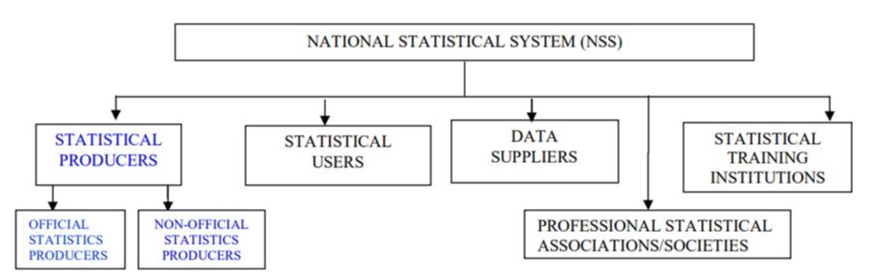
Figure: Components of a National Statistical System (source: Msokwa, Z.E. (2016).
Beyond Official Statistics. International Journal of Applied Science and Technology.
6(2), pp 100-107
Definitions
» Statistics users: There is a wide range of statistics users in every country,from the government to non-state users including development partners.
» Statistics producers: as mentioned, can either be official or non-official. Statistical activities employ either qualitative[1] or quantitative[2] research to better understand phenomena. The NSO, Ministries, Departments and Agencies as well as local governments are notable Official statistical producers. Non-official statistical producers include CSOs, the business community, faith-based organizations as well as academic and research institutions.
Definitions
» Data providers/suppliers: Data providers – whether individuals, organizations - private or public - are the source of the data that is collected. Without them, reliability and quality of the data is difficult to ascertain. Therefore, data suppliers need to be to be well informed on the intention of any data collection exercises, the importance of data and evidence to the society as a whole and they should not be burdened with too many data requests because it may yield fatigue – especially if there are no accruing short/long term benefits to the supply of the data.» Professional Statistical Associations/Societies: the aim of a professionalmsociety is primarily educational and informational; they help to define and set standards for their professional fields and to promote high standards of methodological rigor and quality.
Definitions
» Statistical training institutions: to establish equilibrium, Msokwa (2016) calls for professional statisticians and statistical training institutions to educate the public on statistical matters so as to increase statistical awareness and use of evidence in a country.
Further Reading
- https://www.oecd.org/dac/POST-2015%20P21.pdf
- https://www.researchgate.net/figure/Components-of-the-National-Statistical-System-Source-Central-Statistical-Office_fig2_353992365
- https://www.researchgate.net/publication/353992365
- https://www.oecd.org/sdd/na/1963116.pdf
- https://unstats.un.org/unsd/dnss/docViewer.aspx?docID=190#start

Somo is an eLearning platform that offers a range of online courses focusing on data-driven decision-making, community leadership, financial management, and more.